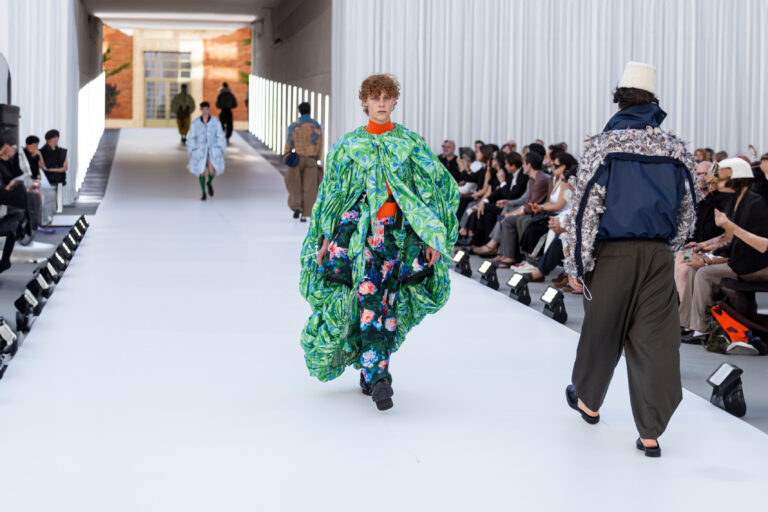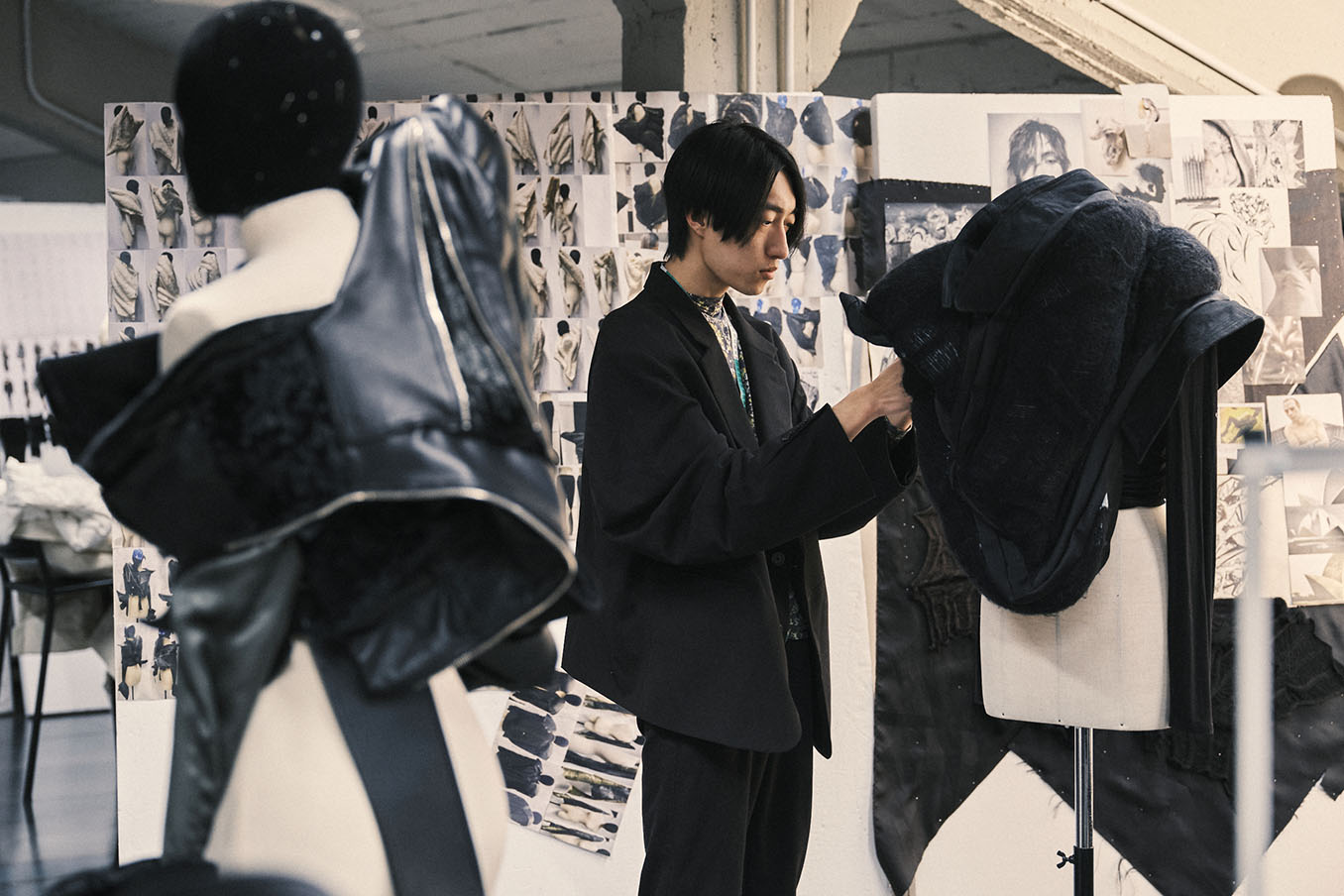
This year, more than ever, our graduating final year students of Fashion Design referred to and were inspired by art, cinema, photography, sculpture, and literature. From Cy Twombly paintings to Pierpaolo Pasolini’s Salò, this guide tells you where you can get your artistic fix in light of this year’s collections.
ANSON LIN
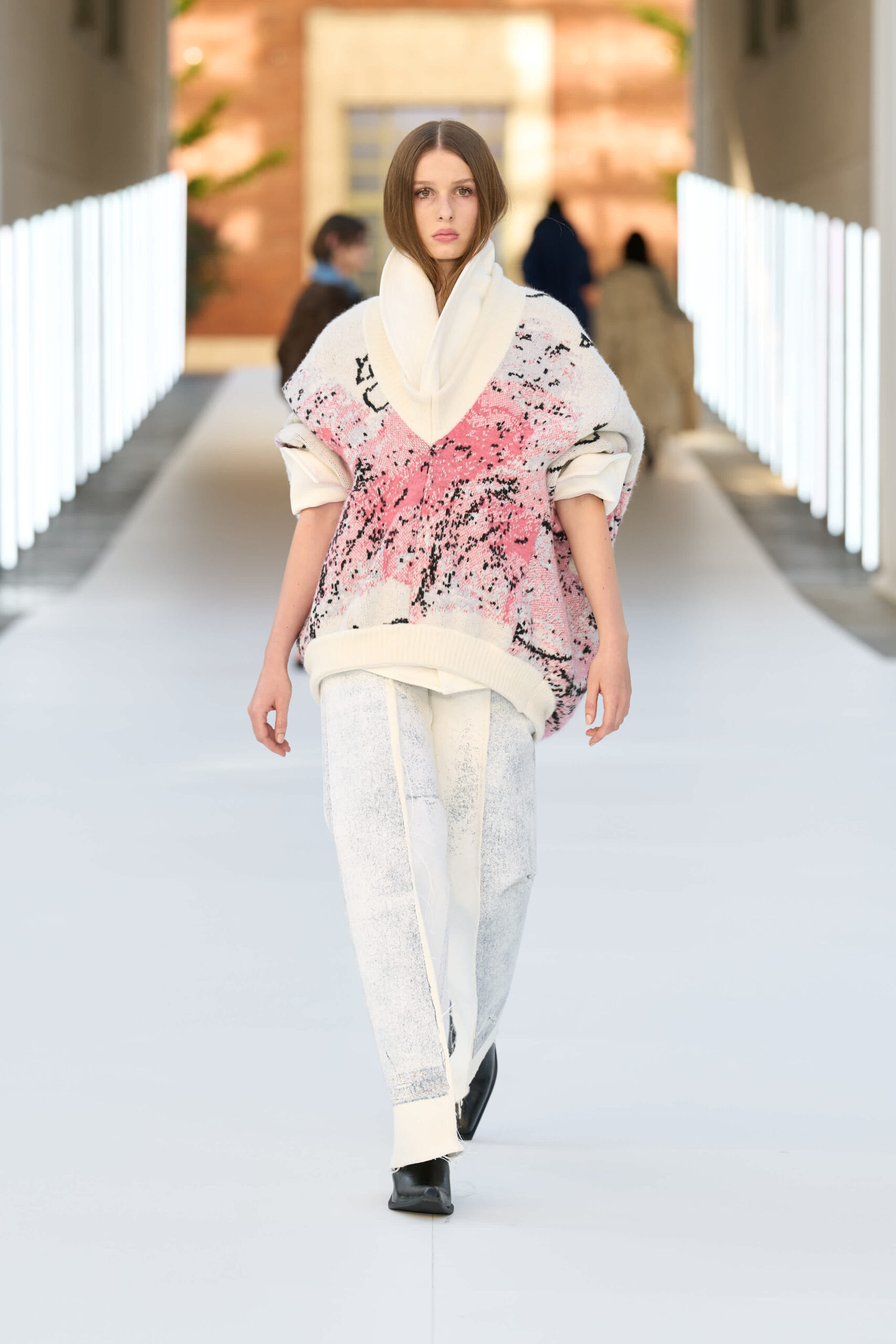
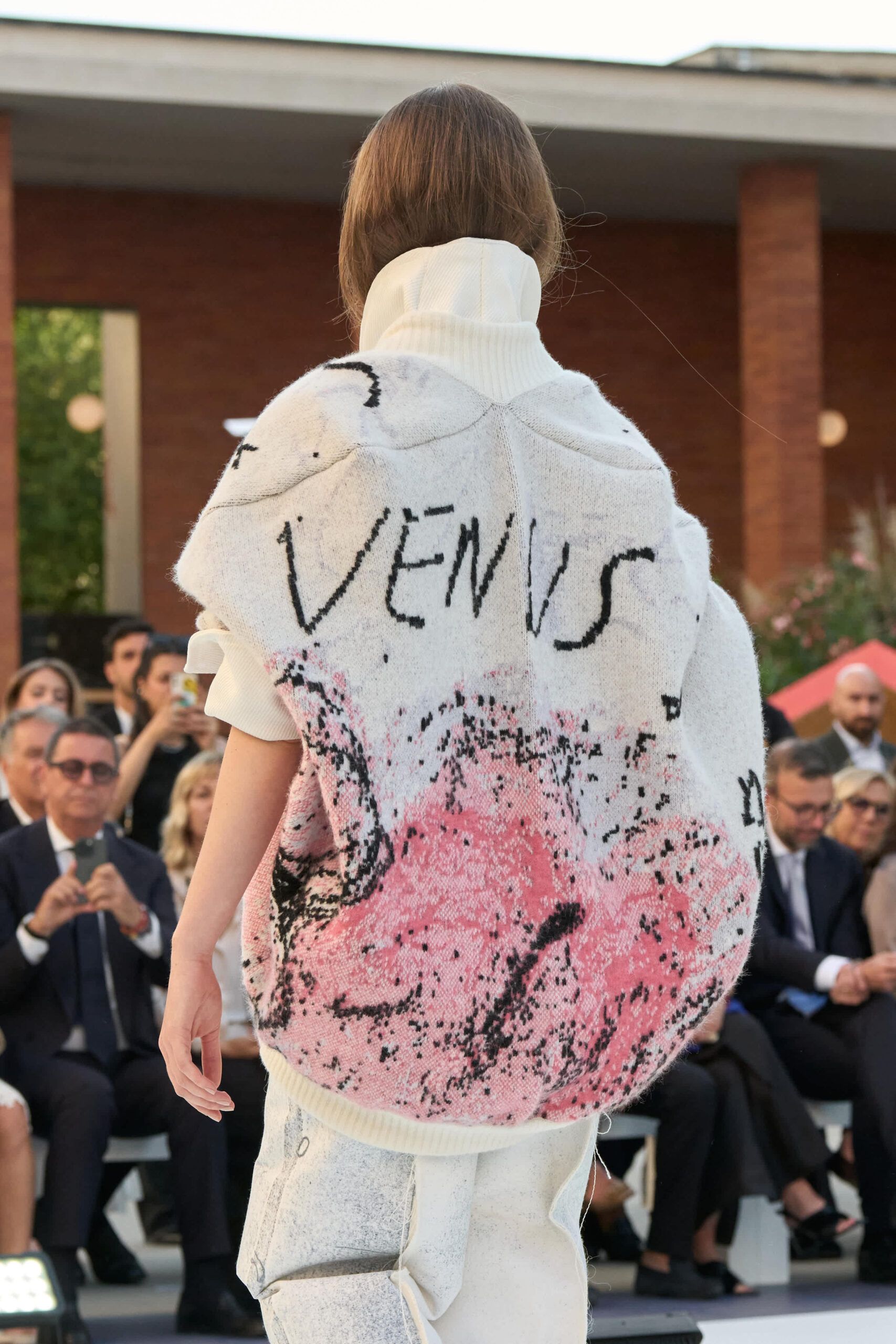
Venus and Adonis (1978) by Cy Twombly is the main inspiration for this knitted jumper by Anson Lin, produced in partnership with Lineapiù, in his collection Packages. The student was inspired by Cy Twombly paintings and sculptures after finding out about the artist’s period in Italy from the 1950s onwards. In the mega masculine era of American abstract expressionism where urban and phallic New York was the centre of this new wave in contemporary Western art, Twombly’s subsequent 40 years of life in Italy was an unusual choice for its time. It became an extremely significant and influential period for the artist and for contemporary art as a whole.
From the 1970s, the artist’s work began to give way to the rhythms of the natural world after a years-long obsession with Greek mythology. Venus and Adonis is a popular Greek mythological story that was popularized by Ovid’s Metamorphoses. Venus falls in love with a mortal youth, Adonis, whose blind obsession with hunting means he refuses to pay attention to the goddess of love. He fatally encounters a wild boar, eventually coming to his bitter end, and in her desperate grief, Venus transforms her love’s blood into an anemone flower as depicted in Twombly’s painting and Anson’s knitwear piece.
The artist’s iconic box sculptures inspired the title of Anson’s collection: Twombly in an interview with art critic David Sylvester, on the occasion of his exhibition on sculpture at Basel’s Kunstmuseum in 2000, said “[Sculpture is] a whole other state. And it’s a building thing. Whereas the painting is more fusing, fusing of ideas, fusing of feelings, fusing projected on atmosphere.” This “building” was influential for Anson’s construction of garments, which incorporates geometric folds and stand up elements like collars or folds.
Where to see works by Cy Twombly:
- Peggy Guggenheim Collection, Venice
- Galleria Nazionale d’Arte Moderna e Contemporanea, Rome, Rome
- Centre Pompidou, Paris
- MoMa, New York
- Tate, London, UK
VICTOR BRIAL
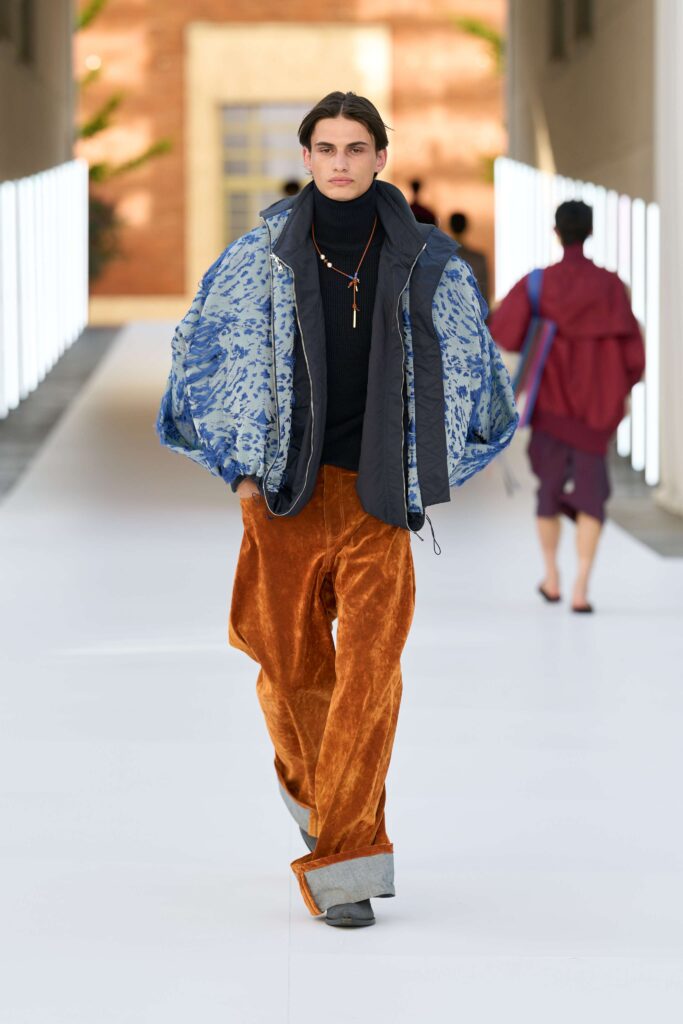
Victor Brial was greatly inspired by the sculptures of Henry Moore for the silhouettes of his collection, Souvenirs of Wandering, combined with the eerie hues and compositions of an artist from the designer’s native La Réunion, Jimmy Cadet, and the extensive worldly textile collection of Karun Thakar.
The works, Interior Figure (1939-40 cast 1959), and Two Piece Reclining Figure (1969-1970), by Henry Moore were pivotal to Victor’s research. Henry Moore was born in 1898 in Castleford, Yorkshire, England, and he changed the face and trajectory of modern sculpture. Seeing art as a civic responsibility that could contribute to the rebuilding of society after the wars of the 20th Century, over the decades his sculpture increasingly explored organic forms that become progressively abstract as a response to the social and cultural changes of the century.
Jimmy Cadet is a still life painter from the island of La Réunion. His still life paintings hold a strong presence, a knowing feeling that is evoked through the objects and scenes he depicts. The lives and the culture of La Réunion and its people are palpable through the precise detail, vivid colours, and innate emotion instilled in the scenes. Elements and objects like embroidered table cloths, medications, cups and bowls, and different fruit and flowers, are visual tokens that bring Victor back into the everyday life of his native island and all who live there.
Karun Thakar’s textile collection also inspired the Souvenirs of Wandering. This internationally recognised archive of fabrics and dress with several thousand examples of textiles from India, Japan, Afghanistan and North Africa is one of the most extensive of its kind and it regularly donates samples to exhibitions and museums all over the world.
Where to see works by Henry Moore:
- Perry Green, Hertfordshire, UK
- Hirshhorn Museum and Sculpture Garden, Washington DC, USA
- Peggy Guggenheim Collection, Venice
- Palazzo Vecchio, Florence
Where to see works by Jimmy Cadet:
- He has had exhibitions at La Galerie des Augustines, Marseille, France
- Follow him on instagram @jimmycadetpainter
Where to see the Karun Thakar collection:
- A year long exhibition, Journeys, has just opened at Osterley Park and House in west London, Blickling Estate in Norfolk and Dyrham Park in South Gloucestershire, in the UK.
- Look out for pieces of his collection in many main textile and fashion galleries, museums and exhibitions around the world
LUSINE MKRTCHYAN
Having grown up beside the Sergei Parajanov Museum in Yerevan, Lusine Mkrtchyan has always been surrounded by his name and his art. The prolific Armenian film director made the film, The Colour of Pomegranates, often cited as the best film to have ever been made, as well as many others that changed the face of cinema and art.
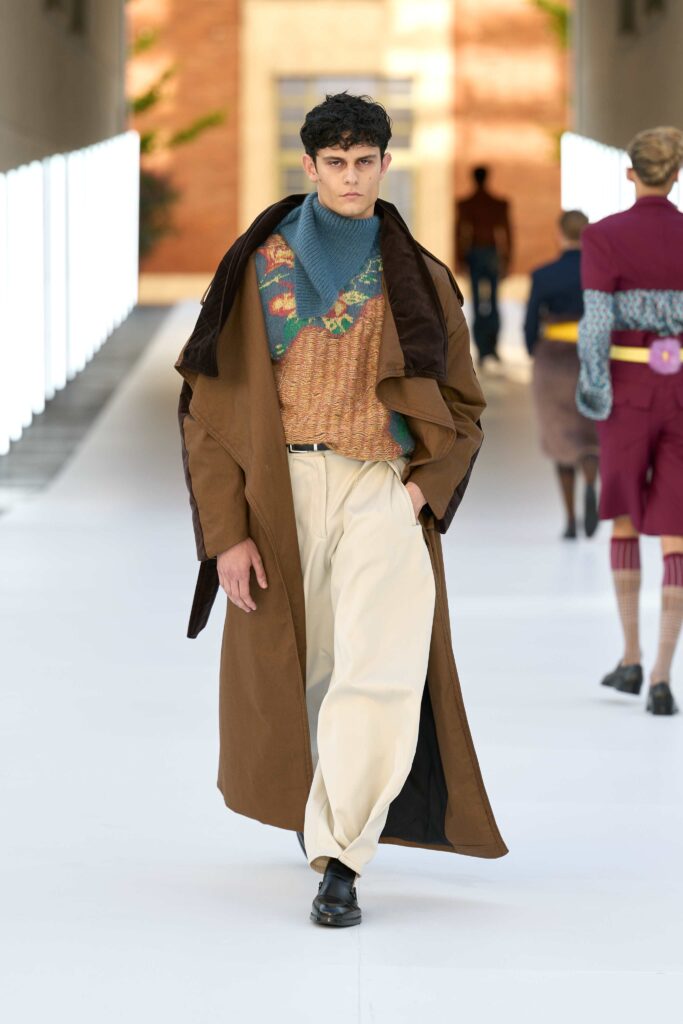
Lusine’s collection, Parajanov Street, imagines him as a quiet, guiding presence throughout the creative process. Shapes draw from the shells and sculptural forms found throughout Parajanov’s museum and films, while the colour palette is lifted directly from his cinematic scenes: shades of green, navy, gold, chocolate brown, grey, and beige, with faded pink, yellow, and deep purple woven through the prints.
The house-museum dedicated to the director is on Parajanov Street in Yerevan, Armenia, and was founded by a dear friend of the artist’s, Zaven Sargsyan. He organized an exhibition of Parajanov’s works of art in the Museum of Folk Art in Yerevan in 1988 which was attended by the director himself; he liked it so much that the location then became the permanent site of the museum. The artist claimed that his origins were not limited to one nation, but divided between his native Georgia, the hospitality offered to him by Ukraine, and then Armenia, where he felt truly at home.
Where to experience the works of Sergei Parajanov:
- Sergei Parajanov Museum, Parajanov street , Bldg 1, Yerevan, Armenia
- Sergei Parajanov’s films are regularly shown at film festivals and cinemas around the world
- The Colour of Pomegranates is available from Polimoda’s library
DIANA AVETISIAN
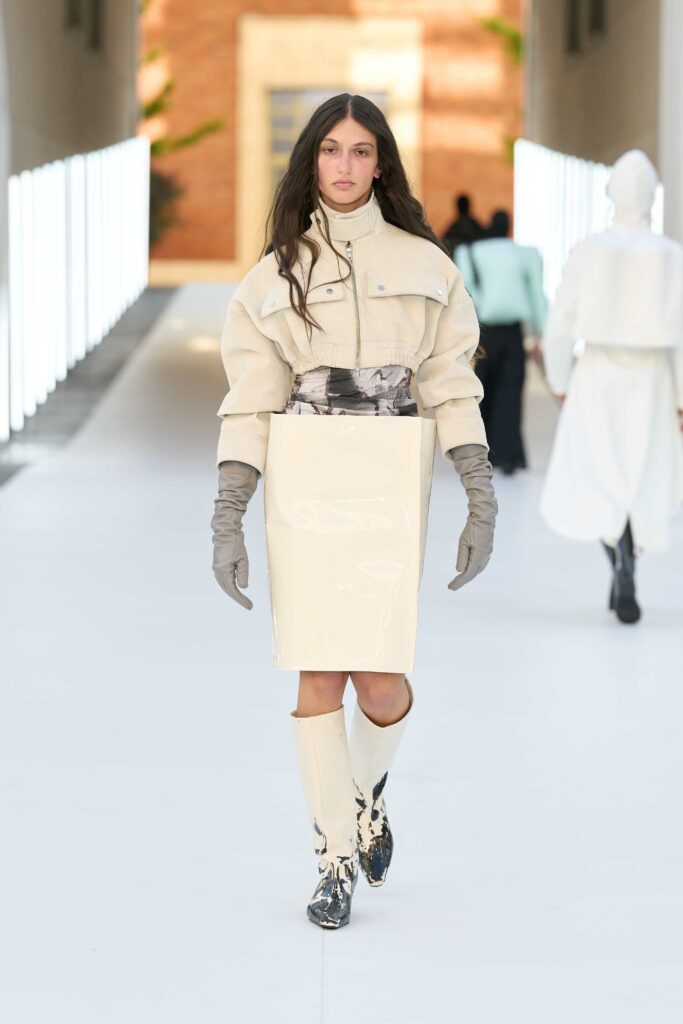
Another Role by Diana Avetisian is a collection that explores femininity as something constructed, performed, and constantly adjusted. Inspired by David Lynch’s Lost Highway, the film was initially a box office failure. Dismissed as incoherent and detached, it has since gained a cult following. Its surreal and time warping plot line is the director’s exploration of the arbitrary and flexible nature of reality. He said in an interview, “reality is huge, if we saw a video of a scene that we remember it would be very different from our memory, it just shows you that how you remember things isn’t necessarily the way it actually happened”. Diana’s collection plays on this by following an actress lost between performance and reality: a woman repairing herself as much as the machines around her.
Where to see David Lynch Lost Highway:
- Many cinemas and film festivals around the world show David Lynch films all year round
- Lost Highway is available from Polimoda’s library
EVELINA KRYVOPUST
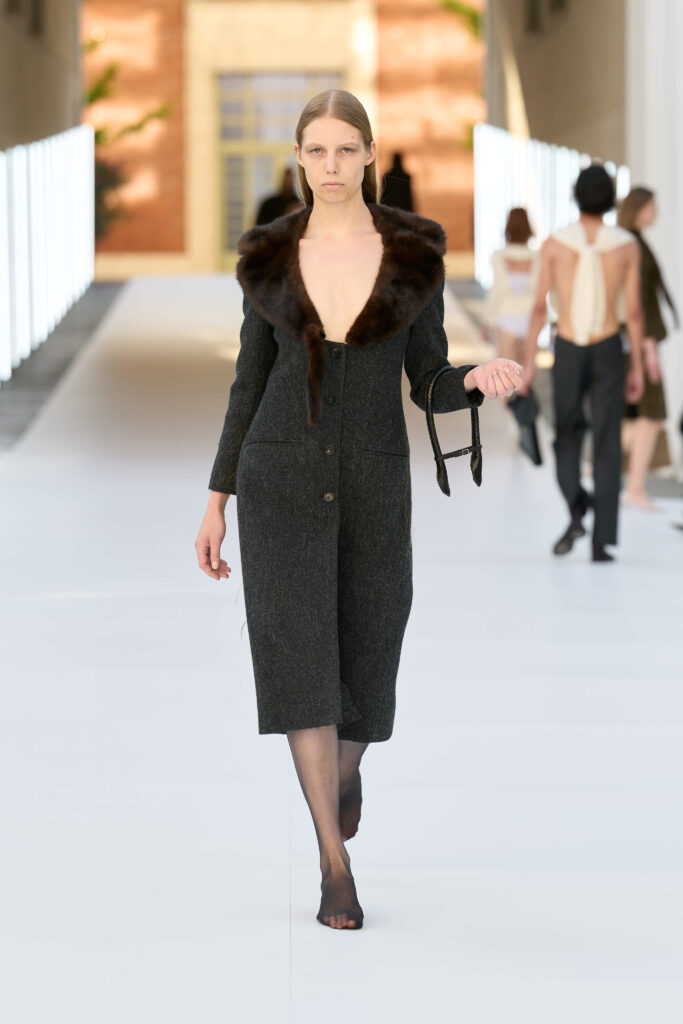
Evelina Kryvopust’s collection, UN, inspired by film The Piano Teacher by Michael Haneke, takes the archetype of the piano teacher, a figure of discipline, control, and precision, as its starting point, exploring what she calls conservative ambiguity: the illusion of transformation without true rebellion. The film is an erotic psychological drama that follows the story of an unmarried piano teacher at a Vienna conservatory, living with her mother in a state of emotional and sexual disequilibrium, who enters into a sadomasochistic relationship with her student. It’s a story of transgression and how authentically one can really live within that.
The collection was also inspired by Pierre Molinier, a French artist who was part of the surrealist movement, connected via André Breton. He became known for the erotic taste to his images, and the photo montage technique that was avant-garde at the time. His influence can be seen in Evelina’s collection through the sheer fabrics and barely-there accessories, as well as its pronounced yet sensual femininity.
Where to see:
- The Piano Teacher by Michael Haneke is available from Polimoda’s Library
- Pierre Molinier is represented in France by Mennour Gallery
MATILDE TERRANOVA
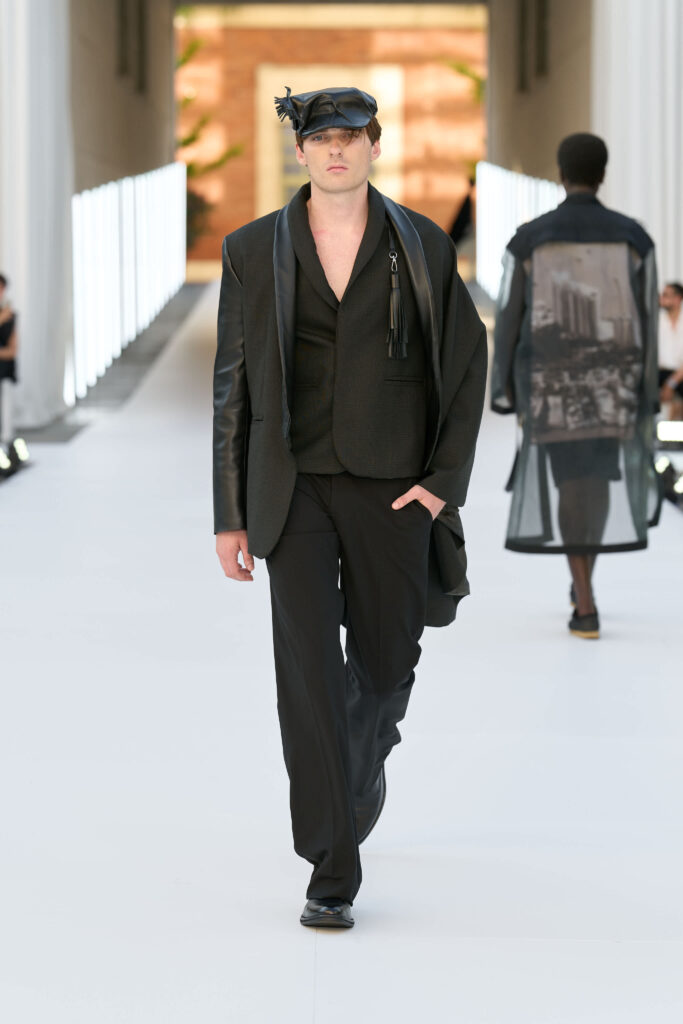
Matilde Terranova’s collection Teenager Boys was inspired by the 1979 Walter Hill film, The Warriors, which sees a gang from the Bronx have to escape back to their home turf on Coney Island after being framed for the murder of a respected gang leader. The film is a selective and insightful look into the different layers of society and youth culture, from the establishment to street gang culture.
Where to see:
- The Warriors is available from Polimoda’s Library
VINCENZO JUNIOR MARRAZZO
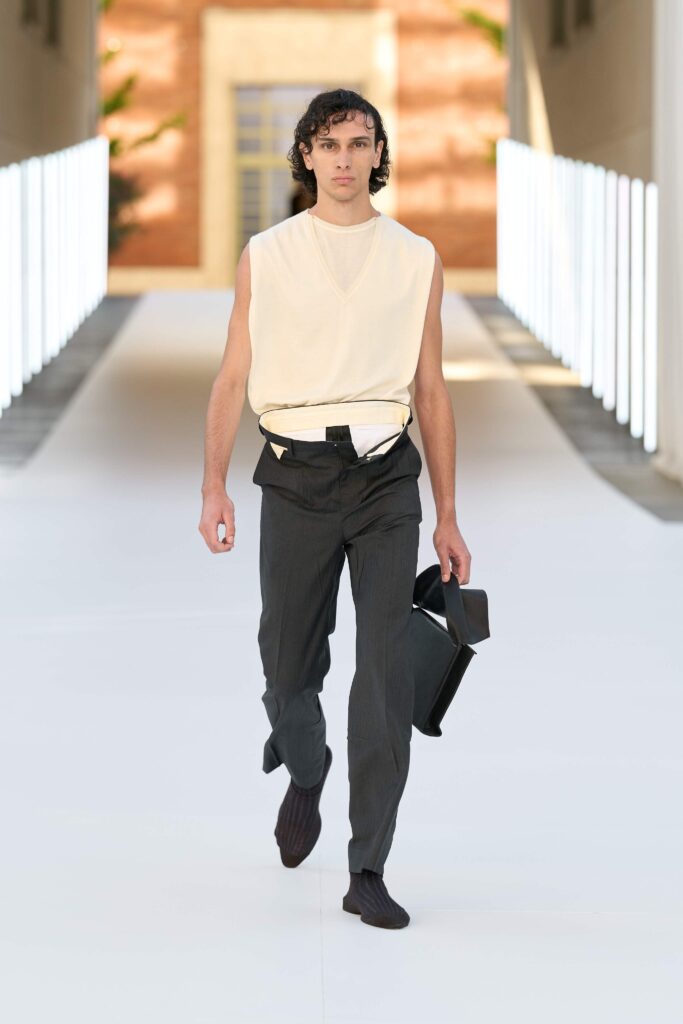
Vincenzo Junior Marrazzo’s collection, titled Il Latte delle Vergini, was inspired by the highly controversial film, Salò, by Italian director Pierpaolo Pasolini. With elements from Dante’s inferno, it adapts the Marquis de Sade’s novel to the 1943–1945 Fascist Republic of Salò, where corrupt libertines subject kidnapped youths to extreme psychological and physical torture as the ultimate metaphor for totalitarian power.
Teorema by the same director was also important for the development of Vincenzo’s collection: a mysterious visitor comes to a bourgeois Milanese family and seduces everyone there, leaving a state of disarray and alienation, exposing the fragility of society’s constructed and upheld mores. The film exposes the impossibility of the middle and upper classes to live authentically while they are ensnared by the materialism and social conventions they have constructed themselves. Vincenzo’s collection delicately incorporates elements that hint at societal uphaul and sexual and ethical transgression, while maintaining a nod to ruling and elite classes.
All films can be rented from Polimoda’s Library as well as a DVD reader, if needed.
BIBLIOGRAPHY
- Christies.com. (2017). CY TWOMBLY (1928-2011), Venere Sopra Gaeta | Christie’s. [online] Available at: https://www.christies.com/en/lot/lot-6369420 [Accessed 7 July 2026].
- Mowen, J. (2025). The Great Outsider | Cy Twombly in Rome | The Pursuit Of. [online] The Pursuit Of. Available at: https://thepursuitof.com.au/explore/cy-twombly-in-rome/ [Accessed 7 July 2026].
- https://brooklynrail.org/contributor/anne-sherwood-pundyk (2024). CY TWOMBLY Sculpture | The Brooklyn Rail. [online] Brooklynrail.org. [Accessed 14 July 2026].
CREDITS
Written by
- Phoebe Owston, Editor of the Journal