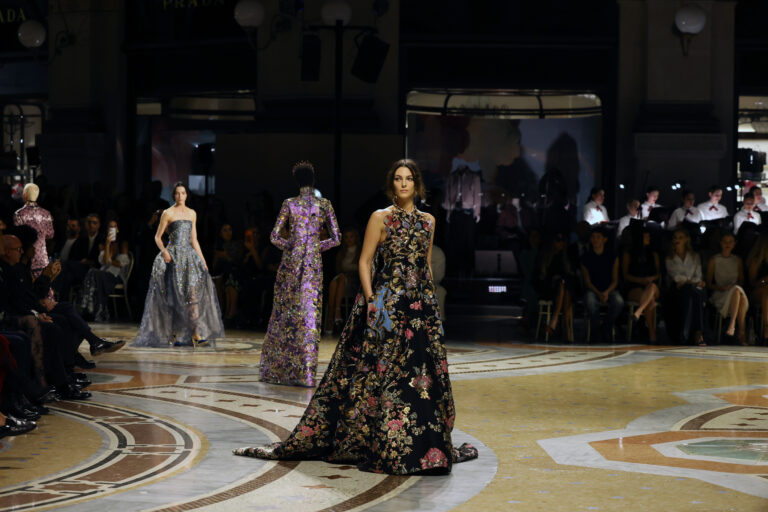
The language around bodies is changing and stringent beauty standards are making a comeback, evident through the popularity of current cultural phenomena like the Victoria’s Secret Fashion Show and looksmaxxing. Far from the body positivity movement of the 2010s, mainstream visual culture’s fixation with perfection has spread into the fashion world; Journal correspondent Riccardo Rinaldi gives us his view on the industry’s return to the impossible body.
On October 18th, the Victoria’s Secret Fashion Show returned to Los Angeles and was streamed live worldwide, capturing the attention of millions of people. But what does its comeback reveal about how mainstream culture views body image today?
The show originally launched in 1995 and became a major pop culture event throughout the 2000s. It drew millions of viewers each year, until the yearly appointment was cancelled in 2019, when the brand faced falling sales and a scandal; the then-chief marketing officer Ed Razek stated that he did not think transgender models had a place in the Victoria’s Secret Fashion Show, and that there was no TV interest in plus-size runway shows. Low ratings, together with criticism about the show being sexist, outdated, and lacking diversity, pushed the parent company L Brands to suspend the shows and rebrand the image of the cult lingerie brand.
After six years, in 2024, the show came back, and in the last three years it has been trying to regain its relevance as the embodiment of beauty and femininity. Under the creative direction of Adam Selman, former chief design officer of Savage X Fenty, the brand has definitely changed a lot, and it displays a bigger variety of cultures, body shapes, and ages on the runway. Data speaks loud and clear: Victoria’s Secret is +10% in sales in Q2 this year (up to $1.611 billion), and the fashion show has reached over 38 million views on YouTube. But what does this tell us about today’s consumers? At a time when fashion increasingly seeks to reflect the consumer’s everyday reality, there may still be a desire for something that transcends it: spectacle, fantasy, and the possibility of inhabiting an idealized world. A new nuance of escapism, without compromising inclusivity.
Despite “curvy models” such as Ashley Graham and Paloma Elsesser being on the runway, and the performance by Megan Thee Stallion, it still feels like “diversity washing”. This is a brand that for decades has celebrated unattainable and unhealthy beauty standards, and now including a few more voluptuous bodies is not groundbreaking; it should be the bare minimum. The whole phenomenon begs the questions, is making beautiful women walk in lingerie really a celebration of female empowerment? Or is it just a marketing strategy?
Victoria’s Secret’s lukewarm effort to embrace the body positivity movement, whether for profit or principle, echoes a wider phenomenon in fashion week shows and Hollywood where Ozempic culture is taking hold and perpetuating an aesthetic not too far from the 90s and early 2000s obsession with unhealthy thinness. This widespread presence of weight-loss medications in pop culture fosters a harmful narrative: remaining in a larger body is a personal choice or a moral failing, inevitably deepening the narrative around fatphobia and weight discrimination.
While women are getting thinner and thinner, men are getting more bulky, as seen with the rise of looksmaxxing culture. This online subculture, primarily popular amongst young men, focuses on maximizing physical attractiveness to achieve what people imagine to be the ideal facial structure, body, and overall social success. But the line between healthy self-improvement and fixation is dangerously thin. Many young men are exposed to unhealthy practices at an age when their self-awareness is still developing, potentially causing harmful behavioral tendencies and unsafely shaping their mindset.
Fashion has reflected this shift in male body preferences. For example, on the recent runways of Gucci by Demna, male models are jacked, with a sharp jawline and super masculine features. For FW 2026, the models’ beefy flesh burst through their skin from tight, high-collared tees. Another example from the same season, is Haider Ackermann invoking American Psycho’s Patrick Bateman in his third collection for Tom Ford. The character of Patrick Bateman could be considered a prototype for the looksmaxxer, as he follows a precise exercise and beauty routine and a strict diet to achieve an appearance. This ideal of masculinity, who views women strictly as an object of pleasure, worryingly also happens to be a serial killer.
After years of body-positive campaigns trying to raise awareness and reduce the gap between impossible beauty standards and reality, Vogue Business, which has been tracking plus-size representation on the catwalks since 2023, has since recorded the skinniest runways ever. With looksmaxxing and women fitting into smaller sizes once again, I find myself asking: do we actually perceive this as more attractive? And if so, why? Our attraction is less about the look itself than about the unattainable, the ideal in its most ephemeral form. The industry has a role to play in this: brands answer and shape that desire, and with little creativity and a consumerist system behind them, they turn our insecurities into commodities. Consumers’s weaknesses and insecurities become tools to be leveraged, transforming vulnerability into yet another commodity.
Another common thread among all these issues is our society’s inability to be happy with ourselves. The search for our own identity is hindered by the constant comparison with others and by the influence of and access to social media. This prevents a more organic, healthier and slower process of self-discovery. Too fat, too skinny, too feminine, too muscular. The truth is hidden somewhere in the middle, but our brains love labels. Fitting into a clearly defined box gives us the impression of being part of the system, but we often fail to realize that we have built a cage around ourselves. We can consider the influence of fashion and consumerist systems, but we often forget that we are the ones who participate in that system, and to actually change it, we can change the way we look at ourselves, in a more kind and flexible way.
CREDITS
Written by
- Riccardo Rinaldi, Undergraduate in Fashion Business
Cover image
- 2022 Polimoda Graduate Collection by Veronika Danyliv. Photo by Marco Gualtieri.