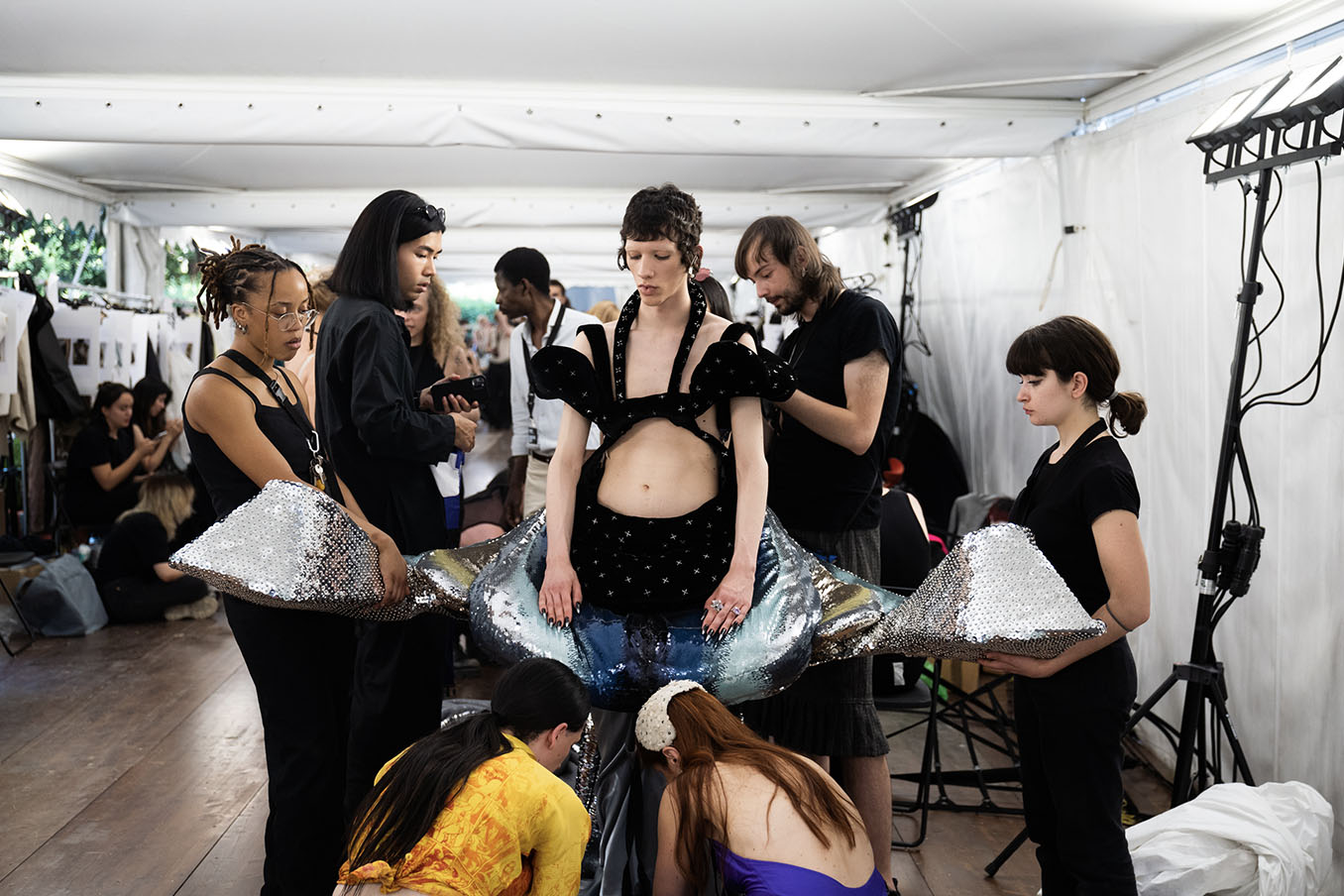
At just 24, Fashion Design student Elias Matso is already making waves in fashion while finishing his final year at Polimoda. Balancing academic deadlines with custom commissions for high-profile clients, he has designed pieces worn by Sydney Sweeney, Julia Fox, Sarah Paulson, Demi Lovato, Shay Mitchell, and Alicia Keys.
With collaborations including Christian Cowan and a growing reputation for his technical skill in corsetry, Matso is forging a path that combines craft, historical references, and a commitment to making fashion feel personal and human.
He spoke to Nishmi Shehara, Fashion Styling student, about his journey through fashion school, his approach to design, working with celebrities as a student, and his vision for the future of fashion.
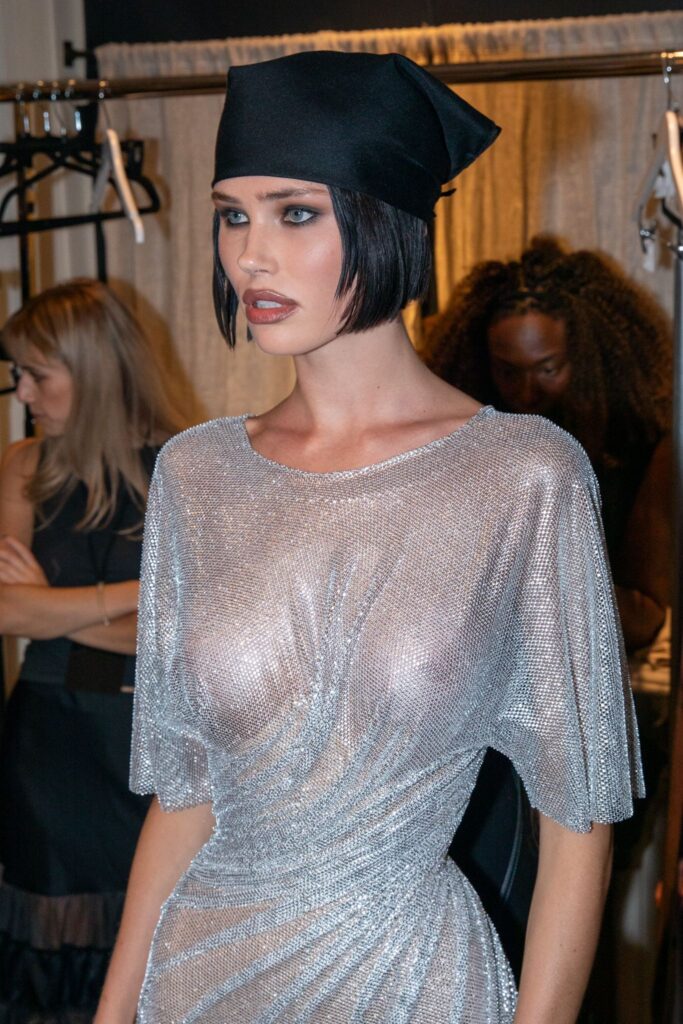
Corsetry is a signature in your work. What draws you to it and how do you see it evolving in the future?
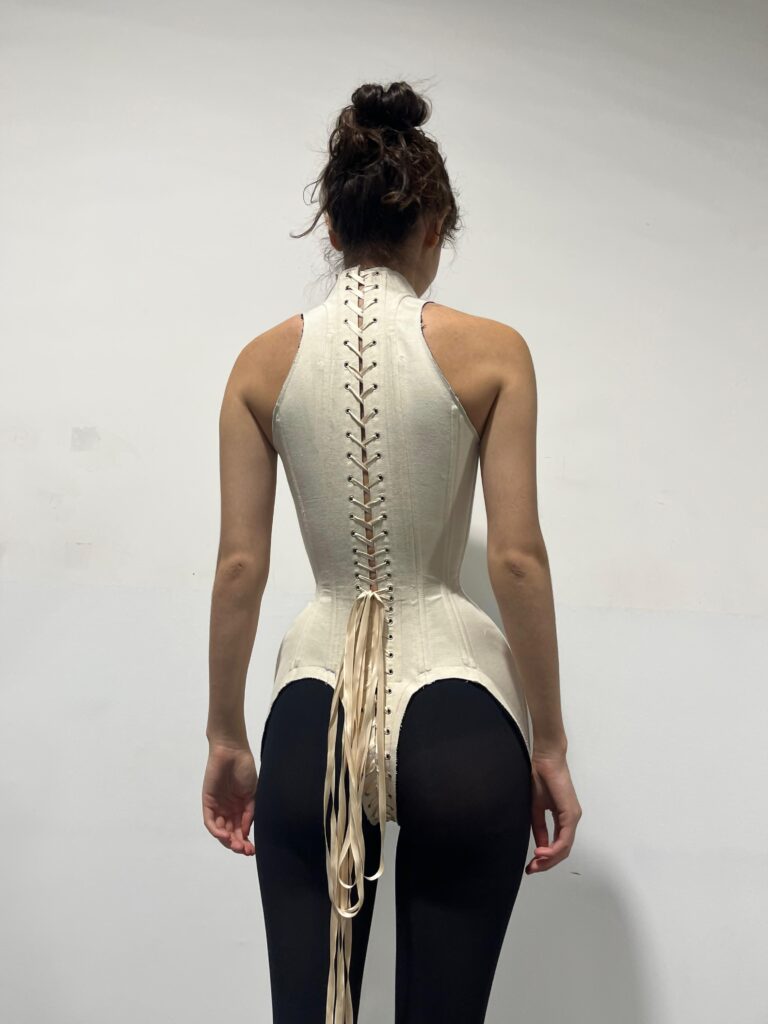
Corsets play a huge role in my work. They’re basic in some ways, but I’ve realized there’s a niche for the kinds of corsets I’ve been making. In some ways my affinity is strategic. I think corsetry will always be fascinating to me, partly because I love it, and partly because it’s how I can make a living. I’m drawn to transformation and the construction possibilities that corsets can provide. The challenge is hiding it; I’m not sure a corset alone can make a look because there’s already so many varieties of that product.
I’m trying to play as much as possible by combining techniques from different decades and applying them to what I need for a garment. A major component of corsetry for me is who will be wearing it, because unless you know the wearer is excited and wants to engage in that kind of dressing, it can easily become an oppressive garment. It has to be personal.
How has the reception to your work been so far? How has your design language evolved since starting at Polimoda?
The reception of my work has been really positive, which often surprises me. I’m very grateful. I’m trying to use that reception to further my work, my platform, and motivation to keep making things. I definitely entered fashion school coming from a more costume lens, which I didn’t even realize at the time. Polimoda encourages building ideas from existing garments and relating everything back to recognizable details.
Something Polimoda has taught me is the importance of immediate impact and clear messaging. That has been something I keep returning to and aiming for; the idea of simplifying in a smart way. The main reason I think fashion school can help young designers is by challenging them to develop a visual language, and by building a practice of actively pursuing knowledge, even after school. In an industry where connections often trump skill, we have to have a desire to learn and evolve consciously.
What have you been doing alongside school to build experience and momentum? How is your work structured?
Social media has proved very useful, I try to dedicate time to creating content people want to interact with, content I would enjoy. It allows me to catalogue my work and think about the way I want to present myself. While instagram’s hold on us is very scary to me, it is an undeniable piece of this industry and it has affected my life at least as much as school. Over the summer I try to collaborate as much as possible, doing freelance work, commissions, or short projects. This past summer I was able to do some custom pieces, including pants for Alicia Keys. My main goal is to meet new people and gain some perspective about the industry I am entering.
Normally, I work alone from start to finish in sketching, pattern drafting, and sewing. Sometimes if there are time-consuming tasks or short deadlines, I hire people I trust who I can delegate to. I’ve worked out of my parents’ house in Maine, a studio in New York over the summer, or on planes with a box of pins on the tray table. I’ve had to set up shop and find extra hands in a lot of different places. I find myself very drawn to logistical challenges.
You’ve collaborated with Christian Cowan and dressed major celebrities. How did those opportunities come about, and what is the process like?
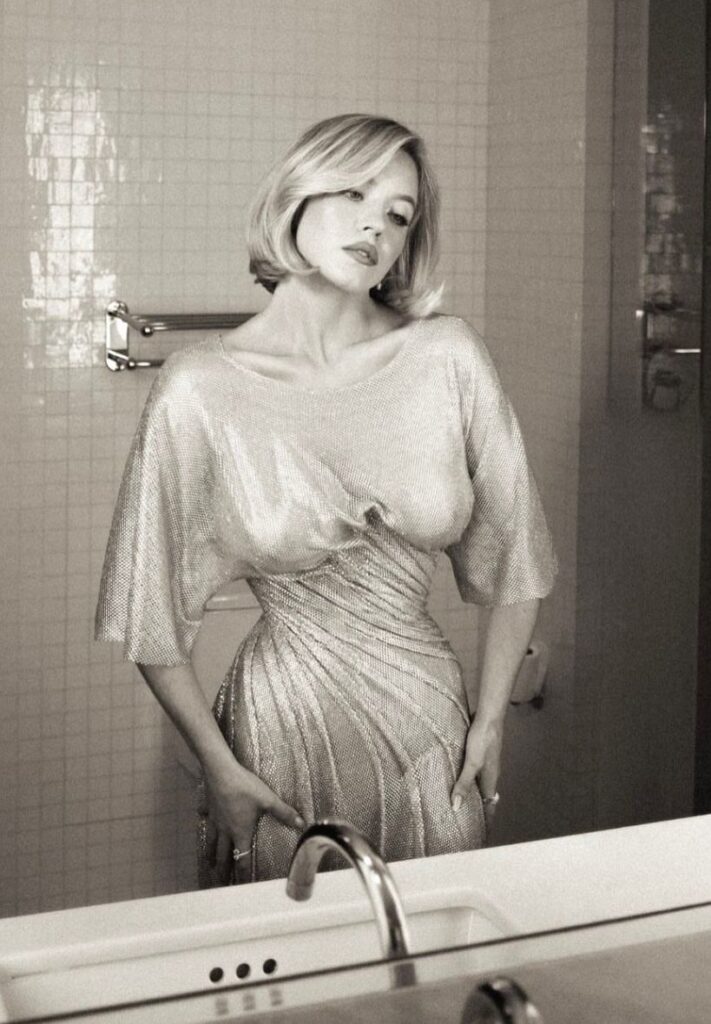
I posted a picture of myself wearing pieces from my third-year collection, one being a twisting yellow corset T-shirt with a graphic I had drawn. It circulated online quite a bit, which led to interactions with stylists, designers, and creatives that I look up to. It was because of that picture that Christian reached out about creating versions of that “twist” for his show. That show led to custom iterations for different celebrities, Sydney Sweeney, Julia Fox, Sarah Paulson, and some other collaborations that are in the works.
In terms of process, it varies. Sometimes the stylists send me mood boards, or a garment as reference, or it can be more open ended. Fittings are amazing but often there isn’t time. Timing is the biggest challenge in all this, especially as a student. Even just coordinating shipping takes more time than I realized. Lately I have had to say no to projects so that I can prioritize pieces for school. It’s a very fortunate situation to be in but I’m eager to graduate so I can be a more active participant in the industry.
Can you walk me through one piece, from concept to final fitting?
The corsets for the Christian Cowan show over the summer were a blast. I made five different shaped corsets in five sizes. We had early castings to ensure models were comfortable and prepared to walk and move in the corsets. We met with each model multiple times for fittings and I got to know them all in a way that felt very special. I was still developing the pattern, so seeing it evolve in five different shapes was amazing. Having a whole space and a stage for the custom, detail-oriented experience, with such high stakes, felt surreal.
Lately, there’s been a lot of talk about a “crisis” in fashion. How do you see these challenges, and how do you approach them?
I’m worried about the shift away from craft and toward hype and momentary financial success. It means people are not developing things that will last. There’s a regression in environmental responsibility, and size inclusivity. There’s also a lack of diversity in leadership roles, with so many major houses being led by white gay men. I find myself fatigued with my own demographic at the moment. It’s an odd contradiction but something for me to keep in mind if I ever have the chance to step into a leadership role. I am a huge proponent of queer joy and representation but “queer” should extend to the entire community.
What do you think the industry is missing right now, and where do you hope your work will be seen in the future?
We’re moving backwards in terms of designing for different kinds of bodies. I love making things for real measurements, not an abstract ideal. I want to contribute to bringing that back. I would love to see my work in more editorials, more performances, red carpets but also on an e-bike. I’d love to have a physical space someday, somewhere people can come and try things on and escape from their actual lives.
As you prepare to finish your final year at Polimoda, what feels like the most important next step after graduation? How does this moment in your life feel?
I think the next step is doing something recognizable, something people not only want to look at but want to wear. I hope to figure out that puzzle. I’m excited to be done with school: even though it’s an amazing place to have creative freedom and support, it isn’t the real world. I was working in NYC before coming to Florence and I miss being in a non academic setting. I’m eager to enter the workforce, to raise the stakes and to see what the rest of my life is going to look like.
As a final year student, how are you thinking about your place in the fashion industry and the kind of designer you want to become?
When I think about finding a place in the fashion industry and what kind of designer I want to be, I think more about the way I want to operate and the ethics I want to stick to than aesthetics. The industry already has a very saturated array of talented creatives, and creatives that work with the aesthetics that I love. I want to prioritize how I interact with people, clients, and collaborators, making sure we’re thinking about joy, visibility, fair pay, and making the industry a little more stable.
With fashion students, there’s this machine of internships and unpaid labor. How do you see your place in this ecosystem?
Many young brands rely on unpaid labor for almost all their production, which disturbs me. Internships play an important role but, there seems to be a cycle that benefits no one. Students work for free, and brands don’t actually invest in the growth of said students because they can move onto other free labor. This could be a symptom of how competitive the industry has become, or an oversaturation of emerging designers. Either way I hope we can break this cycle and think collaboratively and ethically. Fashion should feel human again.
What would you like to do after graduation?
If I had the resources, I might launch a brand with a friend. Realistically, I just want to be employed and inspired. If a brand I respect offered me a job, I’d take it in a heartbeat.
Florence is wonderful, but I definitely want to live in a bigger city. NYC feels like a natural choice but it often seems that young creatives are more supported in Europe in the current fashion atmosphere.
I’d love to be the personal designer to a public figure who I admire; Laverne Cox or Carrie Coon or someone equally incredible. In the early decades of film, actresses had a designer who shaped their entire visual identity. That job doesn’t really exist anymore, but I can fantasize.
Do you have any advice for current fashion students?
Be aware of what other people are doing so you can do something different. At school I’ve learned to look at working designers as competitors because it helps you imagine a role you could fill. I think sleep is underrated, and putting aside time to not think about clothes. It also helps to make things independently, and to look closely at the construction of the clothes you buy. If I was starting fashion school again those are the things I would try and keep in mind.
CREDITS
Written by:
- Nishmi Shehara, Fashion Styling student
Cover image:
- Dress by Elias Matso. Model Lauren Chan. Photo by Dipo Koiki, backstage at NYFW.